
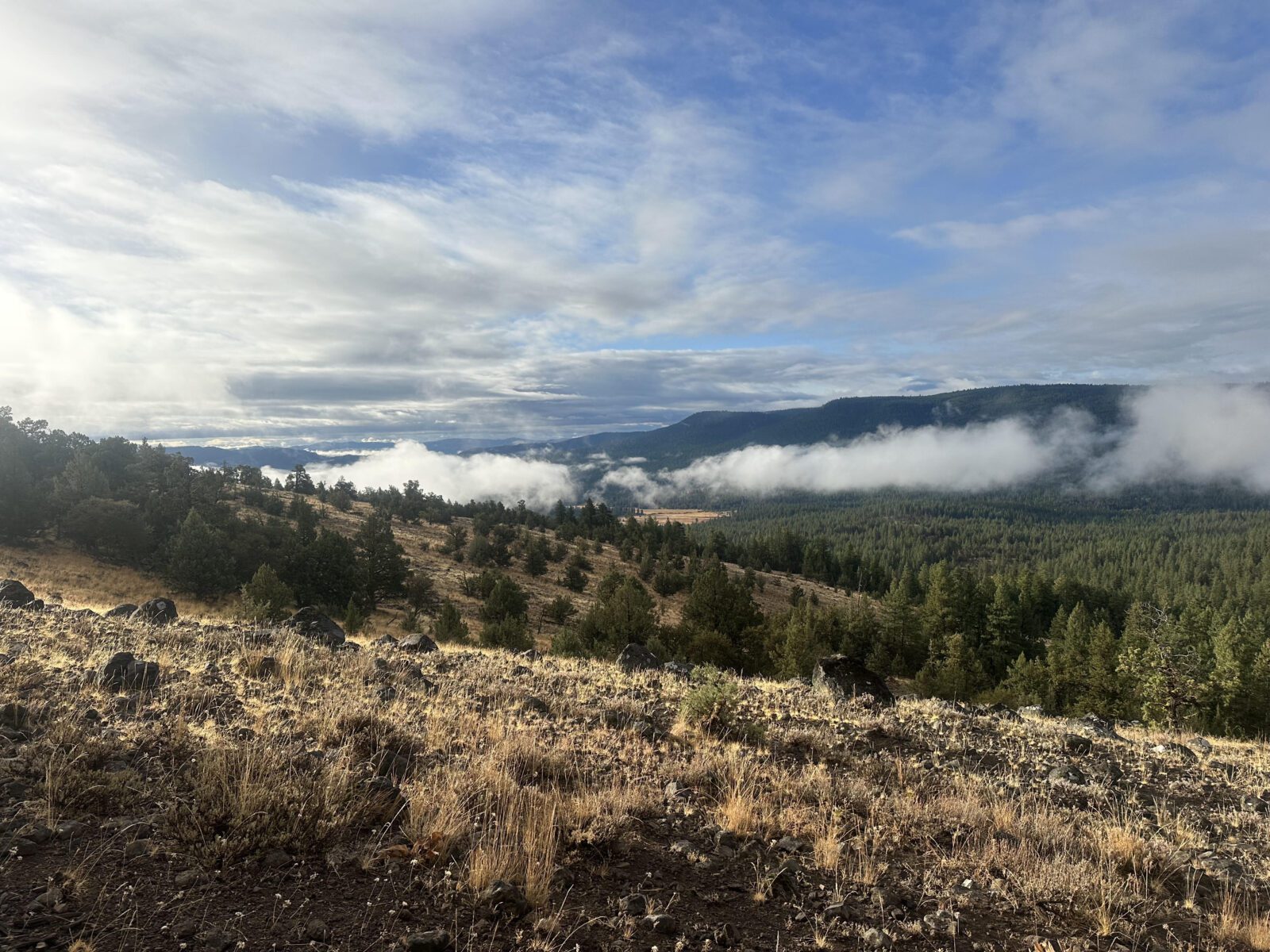
With the fall steelhead season closed on the Deschutes this year (only the second time in my lifetime) I’ve got more time to go elk hunting. Steelhead fly fishing and archery elk hunting are my two favorite things and unfortunately because steelhead guiding is typically what pays the bills I don’t get to hunt as much as I’d like. Here’s a quick story I had to write down so I didn’t forget how amazing the day was from a day in Oregon elk country last week.
What a morning in elk country!
I started hiking in the darkness, easing my way through the timber as the first hints of daylight began to creep into the sky. Somewhere ahead, I heard cow calls. I had the wind angle right, so I started working my way toward them, carefully staying in the timber and using the darkness and thick cover to my advantage.
I worked steadily up the mountain, legs beginning to feel the climb, when halfway up I spotted three cow elk above me.
In this unit, it’s legal to take a cow, which I’ve privately nicknamed “burger wagons on hooves.” Not the most poetic hunting terminology, perhaps, but accurate enough.
I backed down the mountain and picked up a timbered ridge that climbed toward the elk. I worked straight uphill, the slope getting steeper and my legs getting hotter, until I was about 500 yards away.
Then the wind shifted.
Of course it did.
Instead of carrying my scent away from the elk, it was now blowing straight toward them. I immediately backed down the mountain before they could catch my scent and reset my approach.
As I moved, I heard another cow call somewhere above and to my left. The elk were still there, but they were slowly working their way left.
I dropped lower, staying in the cover, and moved laterally toward another band of timber. A thin veil of fog hung over the mountain, and the morning sun was beginning to break through. Everything was wet from the night before, and the damp ground made for wonderfully quiet footing.
I followed another strip of timber uphill, steadily gaining elevation.
Ahead was an opening, with another thin band of timber stretching across the mountainside from left to right. I stopped before the opening, pulled out my binocs and watched.
There they were.
The three cows were in that band of timber, slowly working from right to left and feeding as they went. I still had good wind.
The two elk I could see gradually disappeared into a thick patch of timber. I assumed the third was somewhere ahead of them and decided it was time to make a move.
I dropped my pack and started sneaking across the opening, using one large juniper as my cover. I was lined up perfectly. The two elk couldn’t see me.
The wind was good. I was getting close.
I made it to the juniper and carefully scanned the timber where I expected the elk to be.
Then—47 yards to my right—the third cow spooked!
Dang it!
There they go.
I regrouped, headed toward the top of the mountain and reset for the next phase of the morning.
When I reached the top, I found fresh tracks.
Hmm.
Did those three cows come this way?
I worked along the ridge toward the timber, carefully scanning the open expanses ahead. The last thing I wanted to do was walk over the top and send another elk flying out into the country.
Then I heard a thump.
I looked to my right—straight ahead—and there stood a cow and a calf.
They had seen me.
They took off.
I was already kicking myself, mentally reviewing every mistake I had made that morning, when I looked back and realized there was another elk standing behind me.
I tried to range it.
It spooked.
Thump, thump, thump.
Away it went.
Then I heard a crack below me. I froze. Another crack.
Then another—this one farther to the left.
Then another to the right.
The sound began to build, spreading through the timber below me like a train gathering momentum. Cracking branches. Breaking limbs. Heavy bodies moving through thick forest.
The noise grew louder and louder until it seemed to roll across the entire timbered hillside.
Finally, it reached an absolutely incredible crescendo—one I’m pretty sure could have been heard several miles away.
It went on for more than a minute and a half. I was actually video recording the last part of it.
I’d heard that sound before. It was in the Heppner Unit, when I accidentally bumped into a herd of roughly 100 elk and watched them absolutely rototill the timber as they crashed downhill.
Oh, the shame I felt.
If you haven’t figured it out yet, this is going to be one of those “and then” stories.
And then…
In utter disgrace, I headed across the bald butte, moving away from the enormous herd I had just spooked. I figured they might work their way up the canyon below the big open parks.
I was heading toward a pinch point in the timber.
As I neared the far side of the open butte, I used what little trees and brush were available for cover and carefully scanned the timber edge below.
Wait.
What?!
A cow elk!
Right there at the edge of the grass.
Wait… Two cows. Then I heard a bugle below them.
For what felt like an eternity, one of the cows seemed to have me completely pegged. I held perfectly still, my legs slowly turning into concrete pillars.
Finally, she went back to feeding.
I sat there trying to sort out my next move when I noticed movement below me—but between me and the elk.
A handsome coyote.
He trotted casually through the landscape about 80 yards away, completely unaware of the drama unfolding around him.
The elk went back to feeding as the coyote disappeared, and I became optimistic that he hadn’t spotted me—or, more importantly, hadn’t alerted the elk.
I started crawling, crouching and stoop-walking my way across the slope until the terrain finally gave me some relief from the elk’s all-seeing eyes.
I headed toward a thin band of timber on the open face of the butte. I’d seen a herd in there on Tuesday, and there was plenty of thick, inviting grass.
It was also positioned above the narrow pinch point in the timber where I thought I might be able to ambush the big herd if they came through.
I was about 100 yards from the timber when I saw movement. I focused my eyes. An antelope.
Running away.
Sheesh.
What else was I going to scare today?
I finally made it to the timber band and checked the open areas where I’d seen elk before.
Nothing.
Not an elk in sight.
The wind had now shifted and was blowing up the canyon, so I worked my way to the up-canyon side, which put me close to another large band of timber.
At this point, I decided it was finally time to sit down, eat something and put on another layer. The temperature was dropping, and I was getting hungry.
I found a tree, started settling in and was carefully eyeballing a nice, dry patch of ground to park my backside when, completely unexpectedly—
I coughed.
I actually remember thinking:
Where did THAT come from?
I dropped my pack and looked toward the heavy timber to my left.
And there, less than 40 yards away, standing right on the edge of the timber, was a cow elk.
Staring directly at me.
Of course she was.
I scrambled to get an arrow out, but before I could do anything useful, she took off with a few heavy thumps through the timber.
Sheesh.
Scared another one.
That’s it.
I’m taking a break.
I sat down.
And instead of eating.
Or drinking.
Or putting on another layer.
I picked up my phone and started writing this story before I forgot everything that had happened.
I typed for about ten minutes.
Then I heard a crack in the heavy timber where I’d just seen the cow.
I froze.
Another loud crack.
I told myself, I’m not going over there. I’m not spooking another elk.
So I sat.
And typed.
Ten more minutes went by.
Another loud crack.
I kept typing.
Another crack.
Dang it.
I cow-called.
Come on, elk. You can come to me.
More typing.
About ten minutes later, I cow-called again.
Then—
CRACK.
Crunch.
Crunch.
I couldn’t take it anymore.
I stood up, grabbed my bow and started sneaking toward the timber.
The wet ground was nearly silent beneath my boots, and I stayed in good cover the entire way. When I reached the edge of the thicker timber, I slowly peered into the dark forest.
Movement.
Yep.
That’s an elk.
About 30 yards away.
The cover was thick, but I could see it feeding slowly downhill.
The wind was steady.
And good.
The elk continued working its way downhill.
Then I saw my opportunity.
The cow was about to step into an open window in the forest, with her head hidden behind a tree about 40 yards away.
I drew my bow. Ready.
She stepped out. Broadside.
Right across the open window.
I settled the 40-yard pin into the kill zone.
And waited.
Except she didn’t stop.
I held.
She kept walking.
I cow-called to stop her.
She completely ignored me.
And kept going.
I finally let down and watched her disappear into the timber.
I wasn’t going to take a moving shot.
So there I stood.
Bow in hand.
Hungry.
Cold. Wet. Exhausted.
And having spent the entire morning turning perfectly good elk encounters into an increasingly impressive list of ways not to shoot an elk.
No elk in the freezer.
But one hell of a morning.
**Wow, what a morning in elk country!**